
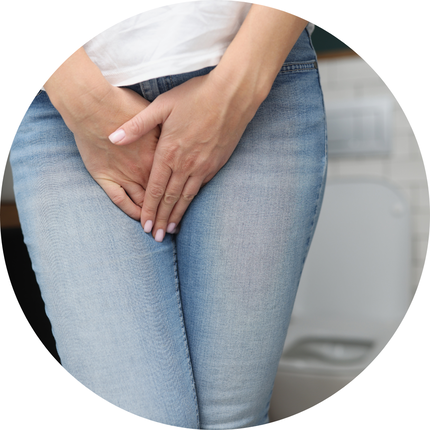
OOpS, a leek... Always one drink too many? Let's talk about it.
Always a little too much? Let’s talk about it.
-
You have to cross your legs when you sneeze
-
You feel an urgent need to go as soon as you walk through the door
-
You avoid certain sports “just in case”
-
You always have a Plan B (or a spare pair of underwear…)
Ladies, let’s talk about urinary incontinence!
Urinary incontinence is defined as the involuntary loss of urine, whether occasional or more frequent. It is a common condition that can significantly affect quality of life, without being a normal consequence of aging or certain life stages.
It affects a diverse population, including postpartum women, physically active individuals, and those exposed to stressors or repeated biomechanical stresses.
Contrary to popular belief, incontinence is not solely linked to muscle weakness. It can also be associated with:
-
poor muscle coordination
-
delayed pelvic floor activation during exertion
-
muscle hypertonicity (excessive tension)
-
inappropriate behavioral habits or compensatory strategies
Phrases We Hear All Too Often
-
“It’s normal after giving birth”
-
“I just have a weak pelvic floor”
-
“I drink less to avoid leaks ”
-
“I’ll just have to live with it”
Bad news: these strategies often perpetuate the problem
Good news: it can be treated with physical therapy!
The Role of Physical Therapy in Pelvic Rehabilitation
Physical therapy specializing in perineal and pelvic rehabilitation is a recognized first-line approach in the management of urinary incontinence.
The initial assessment aims to analyze:
-
Evaluate the coordination, strength, and relaxation of your pelvic floor
-
Understand your triggers (exercise, coughing, urgency, etc.)
-
Develop a 100% personalized plan tailored to your situation
Imagine…
-
Running without a second thought
-
Laughing without stress
-
Getting home without an uncontrollable urge
-
No longer planning your day around the bathroom
I now offer pelvic floor rehabilitation services at Altermed PLT, using a holistic approach that takes into account:
-
your body
-
your lifestyle
-
your goals
No judgment. No taboos. Just solutions.
Make an appointment with Mariama, a physical therapist and nutritionist who will help you stay a little drier.
Read article

When imagination becomes therapeutic: the power of images in physical therapy
Montreal physiotherapy
In physical therapy, we often talk about muscles, joints, nerves, loads, and mobility. This technical, precise language is essential among professionals. But for the person in front of us, this language can quickly become abstract, intimidating, or disconnected from what they actually feel in their body.
This is where imagination comes into play.
Using images, metaphors, and concrete comparisons in physical therapy is not simply a tool for popularization. It is a real bridge between the patient's physical experience, their cognitive understanding, and their ability to actively engage in the healing process.
Understanding for better healing
You are in pain.
In your back, knee, shoulder, or elsewhere.
The most frustrating thing is not just the pain... but not really understanding why it's there or how to get rid of it.
That's why, in my practice, I use images, metaphors, and imagination a lot. Because understanding what's going on in your body changes everything.
Talking about a back that is “overly sensitive” rather than ‘fragile’ or “damaged” radically changes the person's perception of their body. The body is no longer broken, it is protective. This vivid nuance can reduce fear of movement, encourage a return to activity, and reduce hypervigilance.
When a patient understands their problem, they move from a passive state (“my body is failing me”) to an active state (“I understand what is happening and what I can do”). Images facilitate this transition.
Physiotherapy that involves you
Every person is different. Your history, your daily life, your fears, and your goals are just as important as your diagnosis.
Using images helps create a common language that is clear and accessible. You know what you are doing, why you are doing it, and how each step brings you closer to your goal—whether it's getting back into sports, working without pain, or simply moving with more freedom.
In this space between the body, the brain, and the imagination, physical therapy becomes more than just a treatment.
Healing is not just about making pain go away.
-
It's about regaining confidence in your body.
-
It's about understanding your limits without fearing them.
-
It's about feeling that you have concrete tools to move forward.
You deserve clear explanations and human support
If you are looking for a physical therapist who:
-
That takes the time to explain,
-
That simplifies without minimizing,
-
That helps you understand your body rather than fear it,
Then my approach would suit you.
📅 Make an appointment and let's team up to translate what your body is trying to tell you—and above all, to restore your well-being.
Read article
Montreal physiotherapy Montreal nutrition
How can you have a better relationship with food during the holidays?
The holiday season is approaching, bringing with it traditions, gatherings, comforting meals, and sometimes a certain amount of apprehension. Between larger meals, disrupted schedules, and the pressure to “eat well,” it's normal for many people to feel stress or anxiety about their relationship with food.
For some people, this period rekindles the fear of losing control, “overeating,” or feeling uncomfortable. However, it is entirely possible to approach the holidays with more gentleness, flexibility, and kindness toward yourself.
Enjoying the holidays more: nourishing your body, calming your mind
Common statements such as “I'm going to overeat,” “I'll get back on track in January,” or “I shouldn't eat this” create a dynamic of guilt. These thoughts make food anxiety-inducing, when it should be synonymous with sharing, pleasure, and precious moments.
Putting pressure on yourself or anticipating excesses can lead to cycles of restriction and compensation, which disrupt your ability to listen to your body. The holidays are an opportunity to celebrate, not to judge yourself.
Getting through the holidays... together
If the holidays cause you more stress than joy, know that you don't have to go through this alone. Support can help you regain a sense of lightness, reduce guilt, and experience this period with more confidence.
A nutritionist to guide you
The holiday season can be emotionally charged. Professional nutrition coaching can offer concrete tools to help you experience these moments with peace of mind.
As a nutritionist, I can help you:
-
ease anxiety related to meals and gatherings develop a more intuitive, flexible, and compassionate relationship with food
-
find a realistic balance, without extreme restrictions
-
adapt your habits to your reality, your body, and your goals
Some tips for enjoying the holidays with more peace of mind
-
Listen to your internal signals such as hunger, satiety, and cravings.
-
Give yourself permission to enjoy food without self-criticism.
-
Avoid compensating by skipping a meal before dinner.
-
Exercise for pleasure, not to “burn off” anything.
-
Remember that a meal never defines a person's health or worth.
At the Altermed clinic, my experience in nutrition, rehabilitation, and human support allows me to offer a holistic approach that considers the body, mind, and relationship with oneself.
I am available to support you throughout the holiday season. Together, we can create a space of safety, well-being, and balance to approach the holidays with serenity.
Read article